 Government of Jamaica
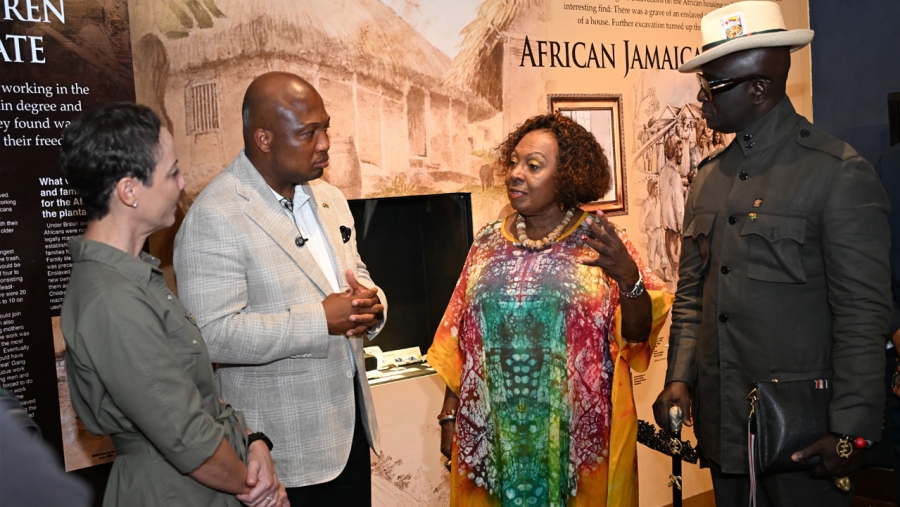
Montego Bay, 27 January 2026 (JIS) - The Minister of Culture, Gender, Entertainment and Sport, the Honourable Olivia Grange, has highlighted the deep cultural and ancestral connections between Jamaica and the Republic of Ghana, describing the Seville Heritage Park in St. Ann as sacred ground where history, memory and identity converge.
She was speaking during a welcome reception and tour of the heritage site on Sunday (January 25), which formed part of a visit to the island by a Ghanaian delegation, headed by that country’s Minister of Foreign Affairs, His Excellency Samuel Okudzeto Ablakwa.
Minister Grange said Seville stands as one of Jamaica’s most significant heritage sites, noting that it served as a meeting place for cultures and civilisations long before the transatlantic slave trade.
“This is considered sacred ground where all the cultures meet,” she said, explaining that the area was once a Taíno settlement and later became a significant site during the Spanish and British colonisation of Jamaica.
She noted that Seville also marks the arrival of the first recorded African in Jamaica around 1503 and went on to become a major plantation estate.
“Thousands of enslaved Africans lived, worked and died on this Seville estate, which was a major producer of sugar for export,” Minister Grange said.
The Minister further outlined Jamaica’s efforts to honour enslaved Africans whose remains were excavated at the site.
“It is those of our ancestors to whom we pay homage today,” she said, adding that July 31 each year is observed at Seville to honour the ancestors whose remains were discovered on the property.
Minister Grange also recalled the historic repatriation of the remains of an enslaved African woman, known as Crystal, to Ghana in 1998 as part of what was dubbed the ‘Great Homecoming’.
“We are proud that the government of Ghana consented at the time for Crystal to be reinterred in her home country where she lies at rest, in defiance of the door of no return,” she said.
Minister Grange emphasised that African cultural traditions survived enslavement and continue to shape Jamaica’s identity, pointing to the resistance by enslaved Africans and the enduring legacy of the Maroons.
She highlighted the strong Ghanaian influence in Jamaica’s cultural expressions, particularly in traditions such as Kumina and Maroon culture, which she said have direct ties to the Akan people of Ghana.
Meanwhile, Minister Ablakwa said the cultural link between Ghana and Jamaica is immediately evident, particularly through music, instruments and dance.
“The same abeng we call it back in Ghana… the drums, same drums that we play up until this day,” he noted, describing the cultural expressions showcased during the ceremony as authentic and unbroken.
He said the preservation of African traditions in Jamaica reflects a powerful legacy of resilience.
“Without any of us coming here to coach you… we were met with culture that is so unadulterated, that is so pure, that we could relate,” Minister Ablakwa said.
END